Christmas Star Garland Embroidery Design
A Cheerful, Compact Statement—Not Just Another Holiday Clipart
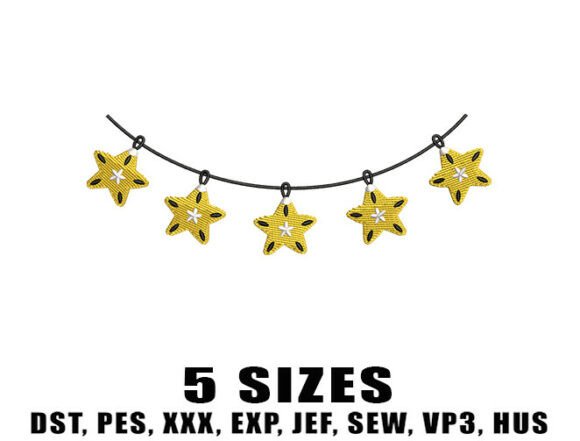
First glance at the Christmas Star Garland Embroidery Design tells you it’s intentionally light—not overloaded, not fussy. Five golden stars strung along a clean black line: simple, rhythmic, and quietly confident. It doesn’t shout “CHRISTMAS!” with tinsel and bells; it whispers warmth, tradition, and handmade care. As someone who’s stitched hundreds of holiday designs for clients—from boutique baby onesies to custom aprons for local bakeries—I immediately saw its versatility. This isn’t background filler. It’s a focal point that works *because* it breathes.
Where It Shines in Real Projects
Last week, I used the Christmas Star Garland Embroidery Design on a set of organic cotton tea towels for a small kitchen goods shop. The black string read crisply against the natural linen-look fabric, and the stars—though small—held their shape beautifully with satin stitch definition. Customers responded instantly: “It feels like something my grandmother would’ve stitched,” one said. That’s the quiet power here—it reads as intentional, not algorithmic.
It’s equally effective on structured items: I digitized a slightly scaled version (no redigitizing needed—just resizing within safe limits) for a unisex sweatshirt line. Placed centered across the chest, it gave just enough holiday spirit without compromising brand minimalism. For Etsy sellers, this is gold: it fits cleanly into mockups for tote bag design, pillow covers, and even embroidered patches meant for jackets or backpacks. On baby embroidery? Yes—but keep it above the waistline on onesies to avoid friction from washing and wear.
Fabrics & Fit: Know When to Lean In—or Step Back
The Christmas Star Garland Embroidery Design thrives on stable, medium-weight fabrics: twill, quilting cotton, midweight denim, and brushed poly-blend sweatshirt fleece. Its linear layout means it adapts well to curved surfaces like caps—if you use proper cap hoops and cutaway + tear-away stabilizer combo. But tread carefully on stretchy knits (think t-shirts or ribbed baby bodysuits): the black string can pucker if tension isn’t dialed in, and tiny star points may distort. Test first.
On dark fabric? Absolutely—just confirm your golden thread has enough sheen to pop. Metallic or high-sheen polyester works better than matte cotton here. On thin or delicate fabric (like voile or lightweight chambray), reduce stitch density if your software allows—or add a lightweight fusible topping. And avoid layering it over seams or bulky pockets: the string element needs flat real estate to lie smoothly.
What This Design Does for Your Brand—and Your Buyers
Customers don’t just buy holiday embroidery—they buy *feeling*. The Christmas Star Garland Embroidery Design delivers subtle sophistication. Unlike crowded motifs or cartoonish stars, it signals craftsmanship. That lifts perceived value on finished product listings, especially for handmade product shops or craft fair vendors. I’ve watched buyers linger longer on Etsy listings featuring this design in clean, lifestyle-oriented mockups—especially when shown on neutral-toned apparel or kitchen linens.
It also supports brand consistency. Whether you’re building a cohesive holiday collection or adding seasonal variety to an existing line, this design doesn’t clash. It pairs naturally with serif typography, muted palettes, and hand-drawn accents—no jarring contrast. And because it’s compact and balanced, it scales well across digital embroidery file previews, printable mockups, and social media thumbnails without losing legibility.
Practical Designer Notes—No Guesswork Needed
Before stitching your first run:
- Always test on scrap fabric—especially if using non-standard thread (e.g., variegated gold) or blending filament with rayon.
- Check thread color contrast on both light and dark backgrounds. A warm gold on charcoal reads differently than on ivory.
- Review stitch density. If the file includes dense fill stitches inside stars, consider simplifying them for baby items or frequently washed goods.
- Confirm hoop size compatibility. This design fits comfortably in a 4x4 hoop—but verify before batching orders.
- Inspect small details: the tips of each star should be sharp, not rounded or merged. If they blur in preview, check your software’s auto-digitizing settings.
- Test in black and white mockups. If it holds visual weight without color, it’ll translate well across merch mediums.
- Use appropriate stabilizer: cutaway for knits, tear-away for stable wovens, and soft cutaway for towels or napkins.
- Verify licensing before selling finished items or bundling the digital embroidery file. Commercial embroidery rights aren’t automatic—even for holiday designs.
Final Thought: Less Is Honestly More
The Christmas Star Garland Embroidery Design earns its place not by being flashy, but by being thoughtful. It respects the fabric it lives on. It gives space to the maker—and to the person receiving the finished product. In a season full of visual noise, that restraint is rare. Whether you’re stitching a single personalized gift or scaling for your craft business, this design doesn’t ask for attention—it earns it, quietly, stitch by stitch.