Bold Red Poppy Floral Embroidery
First Impressions: A Striking, Confident Statement—Not Just Another Flower
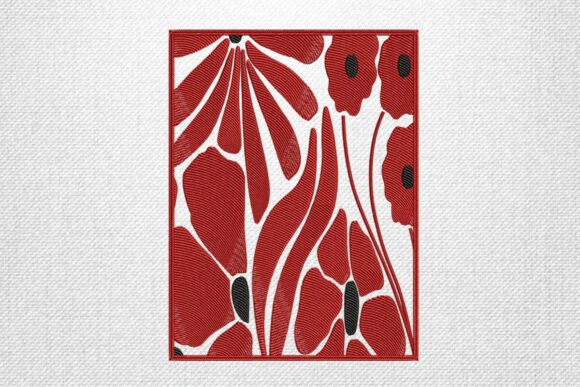
When I opened the Bold Red Poppy Floral Embroidery file, what hit me first wasn’t just the color—it was the posture. This isn’t a shy, trailing botanical sketch. It’s a centered, upright poppy with strong petal definition, a subtle gradient in stitch shading, and clean negative space around its stem. The design breathes. That matters more than you’d think when you’re stitching on a curved sweatshirt yoke or a tapered tote bag seam. As a designer who’s stitched hundreds of floral motifs for boutique clients, I can tell you this one avoids the “generic filler” trap. It feels intentional—like it was drawn for embroidery, not adapted from clip art.
Real-World Test: Stitching It on a Linen-Cotton Kitchen Towel
Last week, I used the Bold Red Poppy Floral Embroidery on a set of kitchen towels for a local café’s holiday gift bundle. I chose the medium size (since the large felt overwhelming on 18″ x 28″ towel hems, and the small lost impact at arm’s length). With a light tear-away stabilizer and 40-weight rayon thread, the satin stitch petals held crisp edges—even over the slight texture of the fabric. No puckering. No thread breaks. What surprised me was how well the fill stitch center translated: not too dense to feel stiff, not too sparse to look unfinished. Customers didn’t just say “pretty”—they paused, pointed, and asked, “Is that real poppy? Did you grow it?” That’s the kind of emotional resonance a strong machine embroidery design earns—not through complexity, but clarity.
Where It Shines—and Where to Pause
The Bold Red Poppy Floral Embroidery is naturally suited to projects where presence matters: custom apparel like crewneck sweatshirts (left chest), embroidered patch applications on denim jackets, pillow covers for modern nurseries, and even minimalist aprons for artisan bakers. Its single-flower structure makes it ideal for personalized gifts—pair it with a monogrammed initial in a clean sans-serif, and you’ve got a cohesive, elevated handmade product.
But let’s be practical: avoid using it on ultra-thin fabrics like chiffon baby onesies without extra backing—or on highly stretchy knits unless you test stabilizer layers first. The petal outlines rely on smooth satin stitch runs; on textured terry cloth or bouclé, those lines soften quickly. And while it reads beautifully on dark fabric (especially navy or charcoal), don’t assume it’ll pop the same on black cotton twill without checking thread contrast in your mockup. On curved surfaces like caps, stick to the smallest size—and always verify hoop size compatibility before loading.
Design Integrity in Commercial Use
As an Etsy seller and small shop product developer, I pay close attention to how a digital embroidery file holds up across contexts. The Bold Red Poppy Floral Embroidery delivers consistent visual weight whether stitched solo or as part of a trio on a tea towel set. It doesn’t compete with text or logos—it complements them. That’s critical for craft businesses building brand consistency. I’ve seen too many floral designs collapse into “background noise” on packaging or social mockups. Not this one. Its boldness translates cleanly into printable mockups, and its clean shape scales well for digital previews without pixelation or jagged edges.
For commercial embroidery shops, this design is low-friction: minimal jump stitches, no nested elements, and balanced stitch density across all three sizes. That means fewer thread trims, faster run times, and less chance of tension-related flaws on mid-tier machines. It also works equally well for men’s and women’s t-shirts—no gendered frills, just confident botanical form.
Designer Notes You’ll Actually Use
- Always test first—run the Bold Red Poppy Floral Embroidery on scrap fabric matching your final project’s weight and stretch.
- Check thread colors in natural light—not just on screen. Red thread varies wildly between brands; some lean orange, others burgundy. Choose based on your fabric’s undertone.
- Review stitch density before scaling. The medium size sits comfortably between 8,500–10,000 stitches (estimate only—verify your file metadata). Too dense on lightweight cotton? Reduce density slightly in your software.
- Confirm hoop size before digitizing adjustments. All three sizes should fit standard 4x4, 5x7, and 6x10 hoops—but double-check your machine’s max dimensions.
- Inspect small details: the stamen tip and petal veining are subtle but legible at medium size. Don’t shrink further unless you’re willing to lose that nuance.
- Test black-and-white mockups. If it reads clearly without color, your customers will recognize it instantly—even in thumbnail listings.
- Use proper stabilizer: light cutaway for knits, tear-away for stable wovens, and fusible + tear-away for nap-free fabrics like linen.
- Verify licensing before selling finished items or bundling the embroidery file as part of a craft business kit. Some sellers overlook this—don’t be that person.
Final Thought: Elegance That Earns Its Place
There’s a quiet confidence in the Bold Red Poppy Floral Embroidery—not loud, not fussy, but unmistakably deliberate. It doesn’t try to do everything. It does one thing exceptionally well: anchor a project with grounded, artistic charm. Whether you’re stitching baby embroidery for a birth announcement, holiday embroidery for a boutique shelf, or custom apparel for a wedding weekend, this design adds value without demanding attention. It says, “This was made with care,” not “Look at me.” And in today’s handmade market? That subtlety is the loudest statement of all.